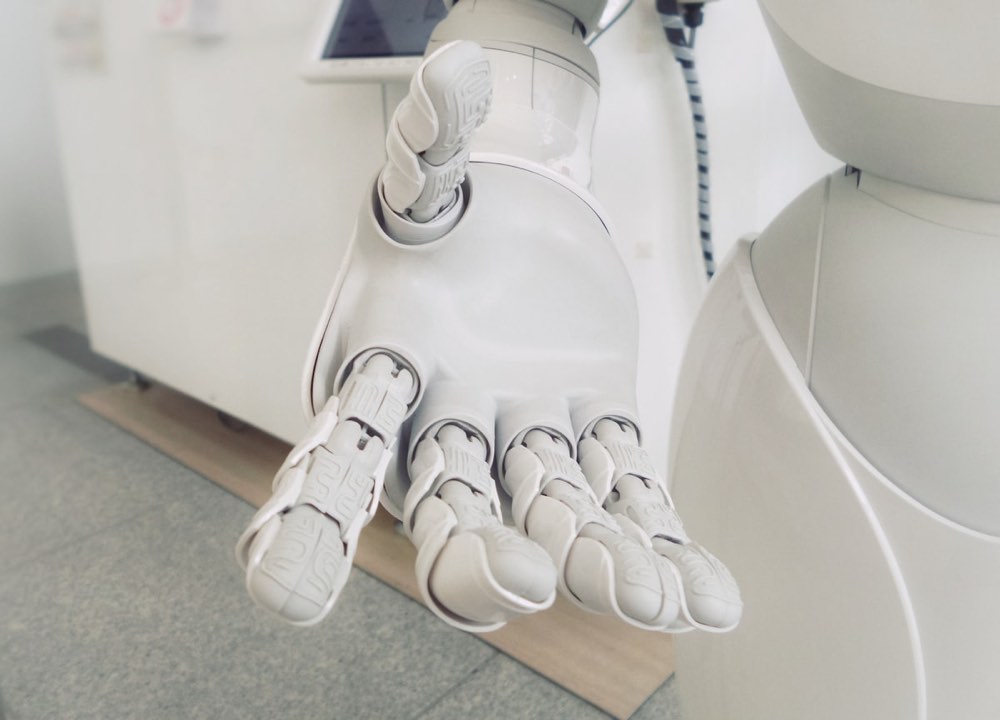
Boston Dynamics has redesigned the hand of its Atlas humanoid robot, and the most striking change is what it left out. Unveiled on October 1, the new gripper has four fingers and 13 degrees of freedom, dropping the pinky in favour of a stronger opposable thumb built for gripping and triggering industrial power tools.
The hand nearly doubles the dexterity of its predecessor and is engineered for two goals that increasingly define the humanoid race: mass manufacturing and training in simulation with reinforcement learning.
Inside the New Atlas Hand
The previous Atlas gripper offered seven degrees of freedom. The new design, referred to as GR3 in the launch video, replaces that GR2 hand with a much more articulated mechanism:
- Thumb: four degrees of freedom, able to slide along the length and width of the other fingers
- Fingers: three fingers with three degrees of freedom each, which can also spread apart to adjust grip on an object already in hand
- Sensing: dense pressure-sensitive tactile sensors across the fingertips and palm
- Size: roughly that of a large human hand, and somewhat stronger on average
Each joint is directly actuated by its own motor, and Boston Dynamics uses a single actuator type across the hand. The drivetrain is backdrivable, meaning the joints can be moved by external force, which gives the robot proprioceptive feedback about contact and load.
In demonstration footage, Atlas picks up a thin drill bit, seats it in a power drill and uses it to tighten nuts. Another clip shows the hand rolling two golf balls around in its palm. Boston Dynamics marked at least one clip as teleoperated, a disclosure that has become increasingly important as the industry faces scrutiny over how much of its demos are autonomous.
Why Drop the Pinky?
The decision to go with four fingers was a deliberate engineering trade-off. A fifth digit would have required three more actuators, adding weight, size, cost, power draw and more parts that could fail.
"The additional dexterity... is not worth the extra complexity of three additional degrees of freedom, the size, the power consumption," mechanical engineer Dylan Thrush told The Robot Report.
The Robot Report also described an internal experiment in which team members taped their pinky and ring fingers together for a day to see what they lost. The conclusion was that a robot hand built for factory work did not need a pinky. Alberto Rodriguez, Boston Dynamics' director of robot behavior, described the process as balancing competing objectives with a mix of intuition and experimentation.
Built for the Factory Floor
The target applications are explicit. Boston Dynamics says the hand is designed to operate trigger-driven tools such as drills, torque drivers, grinders, nail guns and welding torches, along with dexterous pinch and three-finger tripod grasps. Those are the tasks that separate a humanoid that can move boxes from one that can actually work on an assembly line.
The hand arrives a week after Boston Dynamics opened its Robotics Metaplant Application Center (RMAC) at Hyundai Motor Group Metaplant America near Savannah, Georgia, where Atlas is already training. Hyundai, which owns Boston Dynamics, has outlined plans to deploy large numbers of Atlas units across Hyundai and Kia plants, with reporting citing a target of 25,000 robots.
Why It Matters
Hands remain one of the hardest unsolved problems in humanoid robotics. Legs and balance have improved dramatically, but useful work requires grasping irregular objects, applying the right force and operating tools designed for people. Many competitors have chased five-fingered, highly anthropomorphic hands; Boston Dynamics is betting that a simpler, more robust design will win in real factories.
The emphasis on sim-to-real learning is equally significant. Uniform, directly driven, backdrivable joints are easier to model accurately in simulation, which means skills learned virtually are more likely to transfer to the physical robot. That shortens training cycles, a key competitive lever as companies race to scale humanoid fleets.
Finally, designing for mass production signals that Boston Dynamics sees Atlas moving from research showcase to industrial product. With Chinese manufacturers dominating humanoid shipment volumes this year, a hand that is cheaper to build and easier to maintain could matter as much as raw dexterity.
What Comes Next
Boston Dynamics has not published a date for when the new hand will ship on production Atlas units at Hyundai facilities. Industry observers will be watching for autonomous, rather than teleoperated, demonstrations of tool use on real production tasks, the true test of whether four fingers are enough.