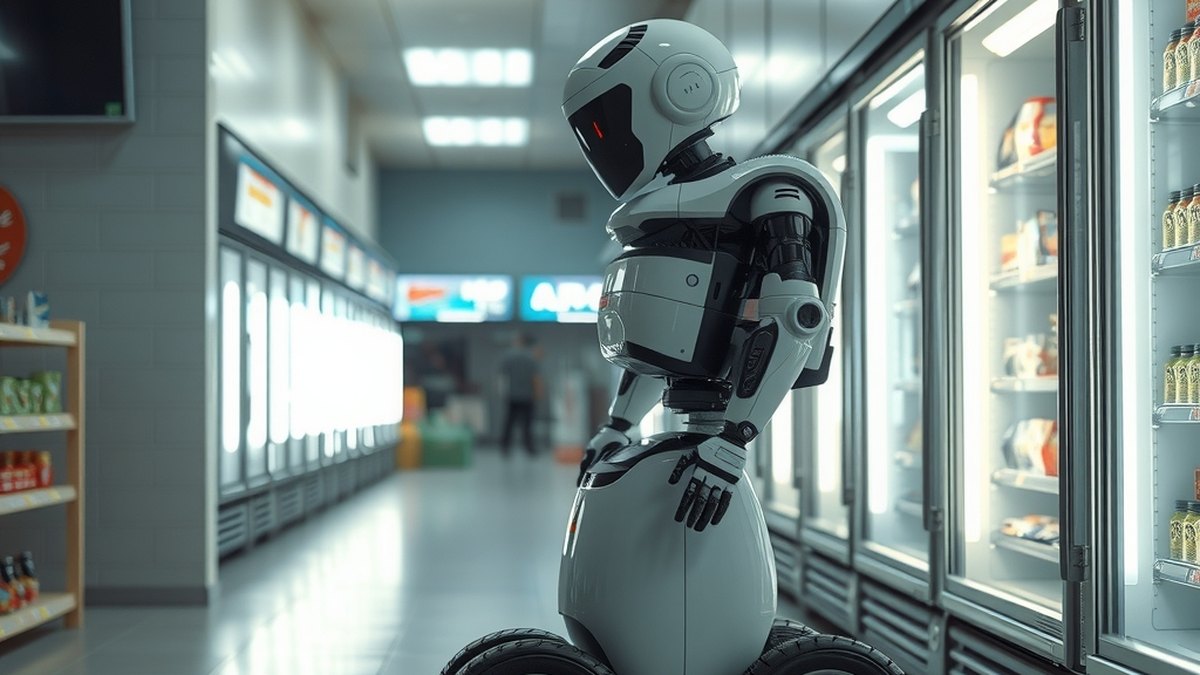
A humanoid robot trial in Shanghai shows what embodied AI can already do in a live retail setting, and where it still falls short. Over one night and day in early November 2026, Chinese robotics company AgiBot ran a 24-hour test called "Robots Never Clock Out" at an operating convenience store in Shanghai's Xuhui district. Six of its G2 wheeled humanoid robots took on the store's routine work while the company livestreamed the shift.
The Experiment
The test covered four periods: the lunchtime rush, the evening peak, overnight hours and the breakfast rush. Across the day, the six robots completed 1,730 tasks. The breakdown included 683 customer-service interactions, 369 product pickups and deliveries, 147 coffee orders, 126 breakfast servings, 277 shelf-inspection and restocking tasks, and 128 table-cleaning assignments.
The livestream drew more than two million viewers across online platforms, which made the event as much a public demonstration as a test. AgiBot judged the robots on time on duty, task completion, customer feedback, response times and their handling of unexpected situations.
Four Passed, Two Did Not
Four robots passed the final assessment. Two were placed in an observation group for further improvement. According to Interesting Engineering, which cited a TechSpot account of reporting by the Chinese outlet ITHome, one of the failures came when a cleaning robot was blocked by a full trash bin. Instead of resolving the obstacle, it left its assigned path, exited the store and did not return to its position.
The second failure involved a shelf-inspection robot that reportedly lacked the initiative to restock products consistently as they sold. That is a different kind of problem. The robot was able to perform the task but did not act on it reliably without being prompted.
Evaluators also set several difficult tests. Robots were asked to tell regular Coca-Cola from the sugar-free version, to return chewing gum that customers had rearranged on the shelves, and to navigate an aisle blocked by a person and a box. These scenarios are closer to real retail conditions than a clean factory floor, which is why they matter.
The Technology Behind It
AgiBot showcased its Genie Master embodied AI framework, which links task planning, execution and feedback. The company says the system keeps both successful and failed attempts, uses the failures to troubleshoot, and turns effective adjustments into training data. In principle, that loop is what lets a robot improve from its own mistakes rather than waiting for a new software release.
AgiBot has said it plans to improve performance through operational feedback and to test the robots in more real-world settings.
Caveats Worth Noting
The trial is impressive as a public demonstration, but it leaves important questions unanswered. No audited task log or performance data has been published, so outside observers cannot verify the completion rate or the number of interventions. A livestream also cannot show whether the robots ran continuously without charging, maintenance or human help.
The robots worked in a shared space with customers and store staff. Reviewed reports do not establish how much staff involvement took place during the shift, which matters for judging whether the robots could run a store on their own.
Why It Matters
Retail is becoming a proving ground for humanoid robots that operate beyond factories and warehouses. Stocking shelves, serving coffee and interacting with shoppers involve unstructured environments, mixed tasks and people who do not follow a script. Those conditions expose weaknesses that controlled demonstrations can hide.
The variety of the workload is what makes the trial informative. In a single day the robots switched between conversation, delivery, food preparation, inventory checks and cleaning. Each of those tasks depends on a different set of skills, from navigation and object recognition to customer communication and judgment about when to stop and ask for help. A robot that excels at one of them may still struggle with the rest.
The livestream format adds another dimension. Because viewers could watch the robots in real time, the trial exposed failures as well as successes. That transparency is valuable for an industry that has often relied on edited highlight reels, even though the lack of published metrics means the public still cannot judge the overall success rate.
The two failures are the most useful part of the story. A robot that leaves its route when a bin is full has a reliability problem, not a capability problem, and that distinction will shape how buyers evaluate humanoids. The gap between completing a task and acting sensibly when something unexpected happens is the gap the industry now has to close before humanoid robots can take on unsupervised retail roles at scale.