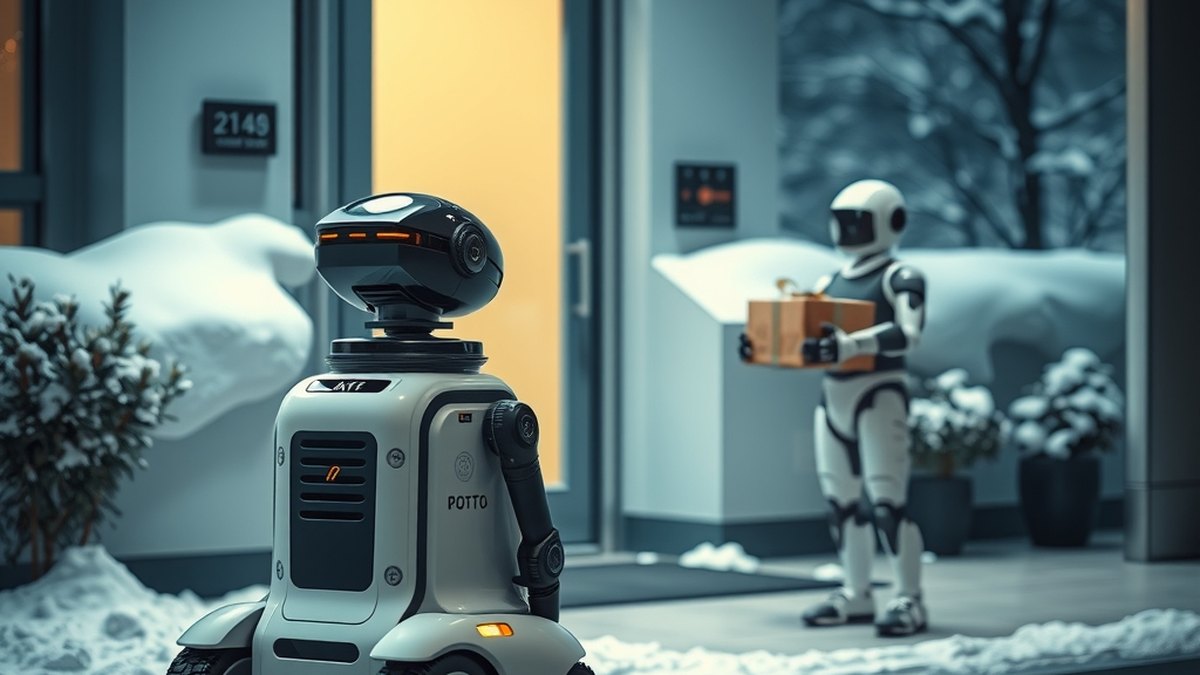
Russia's Yandex is preparing a pilot that would pair its delivery rovers with humanoid robots, according to a report by the business daily Kommersant. The humanoids would handle the indoor stage of a delivery, the part wheeled machines cannot manage. Yandex has not confirmed the plan's details, and the experts quoted in the report describe it as a test more than a commercial venture.
How the Pilot Would Work
Yandex's delivery rovers already carry orders outdoors. According to Kommersant's sources, a rover would bring an order to a building's entrance, and a humanoid robot would carry it inside. The split reflects a basic limit. Rovers cannot climb stairs or cross thresholds, so the final stage of a delivery calls for a different kind of machine.
The report says the pilot would begin by the end of 2026. Two IT-industry sources described the plan to the paper, and the report does not say how many sites would be included. The goal, as described, is to see whether humanoids can handle the indoor leg reliably enough to justify further development.
What Yandex Has Said
Yandex has not endorsed the humanoid plan publicly. Its press service confirmed only that it is testing "the delivery of orders from delivery robots to employees' workstations," and said it would share further plans separately. That wording points to a workplace trial rather than a public service, and it leaves the humanoid component unconfirmed.
Expert Skepticism
Experts polled by Kommersant were blunt. They called the effort "more a pilot project to test the technology than a commercial venture," and one described it as "a branding exercise." Their objections centered on economics and hardware. Running humanoid robots is expensive, their service life and carrying capacity are limited, and safety in shared buildings remains an open question.
One source also put the timeline in perspective, saying it would take more than a year before humanoids appear on the street. Even if the indoor trial goes well, the outdoor version is not expected soon.
Rovers Give the Project a Base
Yandex is not starting from scratch. Its wheeled delivery rovers have made commercial deliveries since December 2020. As of the second quarter of 2026, the company had about 1,000 of them operating in more than ten Russian cities. That fleet gives Yandex operating data and an existing delivery network to attach a humanoid stage to, which makes a rover-plus-humanoid design more plausible than a standalone robot courier.
Why It Matters
The story illustrates a wider pattern in humanoid robotics. The most realistic early jobs are often narrow handoffs inside controlled environments rather than general-purpose work. Stairs, doorways and mixed foot traffic are exactly what separate a demonstration from a deployment. Operators and investors will look for measurable results, such as completion rates, error recovery and cost per delivery, before drawing conclusions. None of those figures have been published for this pilot.
The project also shows how companies are combining robot types. A low-cost, reliable rover handles the long, open route, while a more expensive humanoid is reserved for the step that requires human-shaped mobility. That division of labor may prove more practical than asking one machine to do everything.
A Test of Hardware and Trust
Indoor delivery is a demanding setting for any robot. Corridors, elevators and building staff all introduce variables that a warehouse or a sealed test course does not. A humanoid carrying a customer's order through a shared building must navigate people and obstacles without damaging goods or endangering anyone nearby. The pilot, as described, would show whether a humanoid can complete that route repeatedly.
Trust is the second test. Residents and employers will need confidence that a machine entering their building is safe and that parcels are handled properly. Yandex's current confirmed work, delivering orders to employees' workstations, is a controlled environment where those questions are easier to answer. Expanding into residential buildings would raise them much more sharply.
The Economics Are Unclear
The business case is still open. Humanoid robots are costly to buy, maintain and insure, and their value depends on how many deliveries they can complete per shift and how often they need human help. Rover-only delivery already has an established model in Russia, so a humanoid stage would need to show a clear advantage in cost or service to justify its place in the chain. Until Yandex publishes figures, the economics remain a question rather than an answer.
For Yandex, the most useful outcome of a pilot like this would be a clear record of what a humanoid can and cannot do on a real building route. Without published completion rates, costs and incident data, the pilot would show little beyond the fact that it was attempted.
What to Watch
- Whether Yandex names the sites, robot models and timeline in a formal announcement.
- Whether the indoor pilot publishes completion rates and safety incidents.
- How the company prices a humanoid stage against the rovers it already runs.