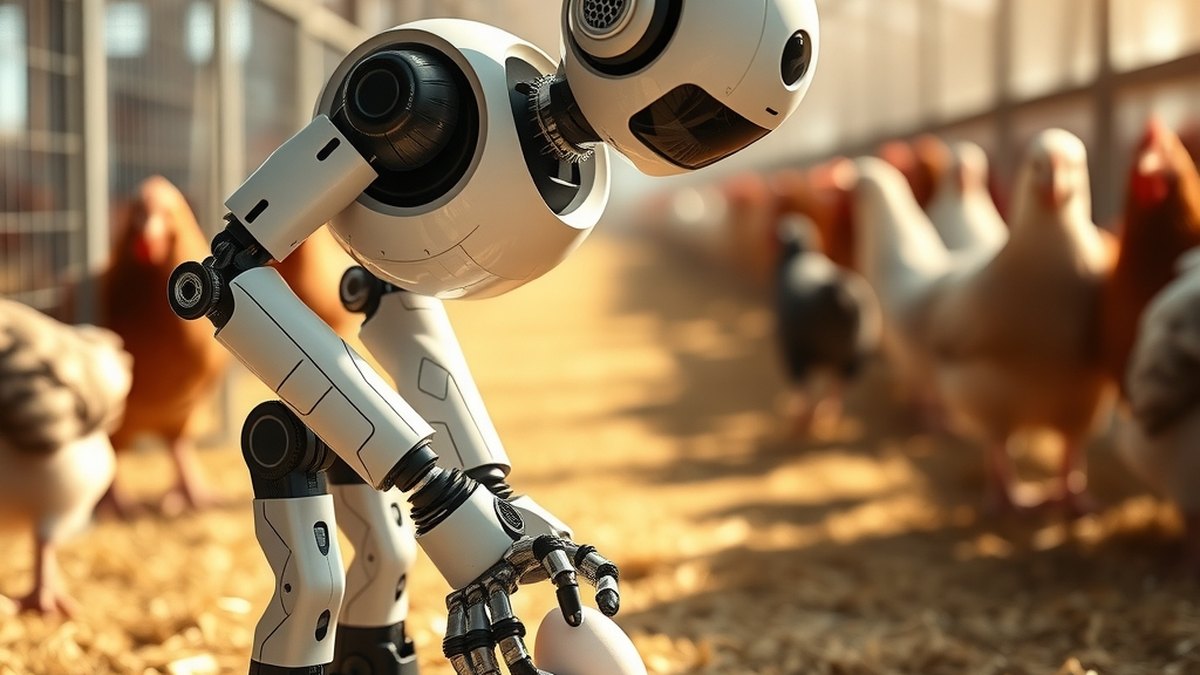
North Carolina State University researchers are developing Howl, a humanoid robot built on the Unitree G1 platform that is meant to find and pick up eggs laid on the floors of cage-free poultry barns. The project addresses a real and costly problem: eggs that land outside nesting areas must be collected by hand, and the labor to do that is hard to find. The team aims to have the robot performing these tasks by early 2027, though the work is still in development.
The Problem With Floor Eggs
Cage-free systems give hens more room, but they also create eggs in places that are slow to collect. Coverage of the project cites floor eggs making up 2% to 15% of production. On a farm with about 100,000 birds, that can mean as many as 15,000 floor eggs to gather in a single day. Delays in retrieval can affect product quality, which is one reason the task matters to producers.
The project is framed around three goals: addressing labor shortages, reducing egg losses and improving bird welfare. Poultry science faculty involved in the work have also pointed to the value of tools that help producers manage flocks more effectively, including systems that assess the health of individual birds. The Howl effort is one piece of that broader push.
How Howl Is Being Built
Howl stands about four feet tall and is based on the Unitree G1 humanoid. The work is run through the university's Artificial Intelligence and Robotics Lab, led from the Department of Biological and Agricultural Engineering. The robot's job breaks into three steps: detect floor eggs, approach them and pick them up with its robotic hands.
Much of the control software is being built largely from scratch, according to reporting on the project. Researchers use virtual reality to demonstrate tasks and program movements, then apply reinforcement learning and imitation learning so the robot can learn to handle eggs. Egg handling is a demanding manipulation problem because the target is small, fragile and sits on a surface that may be cluttered or uneven.
Students are building many of these abilities through virtual reality manipulation and other machine learning methods, the university has said. That approach lets the team iterate on grasping behavior before the robot is tested in a working barn.
Building on Earlier Poultry Robotics
Howl is a bet on the humanoid form for barn work. A robot with two arms and hands can, in principle, reach into tight spaces and handle eggs the way a worker would, while a wheeled or legged platform may be better suited to surveying a barn quickly. The team's choice reflects that the hard part of the job is manipulation rather than navigation.
That trade-off is central to the project. Egg collection needs two skills at once: finding eggs on a cluttered floor and grasping them gently enough to avoid cracks. Vision systems can detect eggs, but the hard part is manipulation, which is why the team is leaning on virtual reality demonstrations and imitation learning rather than relying only on detection.
Bird welfare adds another constraint. A robot moving among hens must avoid startling them or causing injuries, and it must work around nests, feeders and other equipment. Those requirements make the barn a harder environment than a controlled lab bench, and they explain why the team is treating simulation and staged tests as necessary steps.
Timeline and Open Questions
The team is refining Howl's programming and training. Egg-detection and retrieval simulations are expected to be finished before practical demonstrations begin, and the target for performing these tasks is early 2027. Reporting does not include detection accuracy, grasp success rates, costs or any on-farm trials. The project has not yet been demonstrated in practical settings.
That gap matters. A humanoid that works in simulation must cope with dust, uneven flooring, birds moving nearby and eggs that differ in size and shape. Because farm volumes are large, even a modest failure rate could leave many eggs uncollected, so the next useful data points are measured retrieval rates in real barns.
Why It Matters
Agricultural robotics often gets less attention than warehouses and factories, yet poultry operations face tight margins and persistent labor shortages. A humanoid is an interesting choice for barns that were built for people. It may fit existing spaces and tools, but it also raises a practical question: is a general-purpose body more cost-effective than a machine designed only for floor-egg collection? The reporting does not answer that, and the team has not published cost comparisons.
For producers weighing automation, the cost question will decide adoption. A machine has to pay for itself through recovered eggs, reduced labor and fewer missed collections, and each of those depends on the robot's reliability in real barns. Until the team publishes measured retrieval rates and cost estimates, any financial case remains speculative.
For producers, the near-term signal is modest. Howl is a research platform, not a product that can be bought. For the robotics field, the project shows humanoid platforms being pointed at narrow, high-volume tasks rather than only at demonstrations. The milestones to watch are completed simulations, published detection and retrieval results, and the first supervised trials in a poultry house.