Munich-based Agile Robots has closed a $500 million Series F led by SoftBank Group, valuing the company at $8.5 billion. The round, announced November 12, brings the company's total funding to roughly $2 billion. It arrives as investors pour money into physical AI, and the real test is whether Agile can turn factory capacity into robots that customers actually receive.
Who Joined the Round
SoftBank led the round, with NVIDIA, Hitachi, Hitachi Ventures and T.Capital also taking part. The $8.5 billion valuation marks a large step up from earlier rounds. However, the company has not published a round-by-round funding history, so much of its roughly $2 billion total cannot be traced in public records. The investor split for this round, including any share held by Chinese investors, has also not been disclosed.
For SoftBank, the investment fits a broader push into physical AI. The company already holds other robotics assets and has been negotiating over ABB Robotics, although that deal faces regulatory hurdles. Agile's round is one of several large checks written this month into companies that build machines with AI at their core.
Factory Capacity Versus Shipments
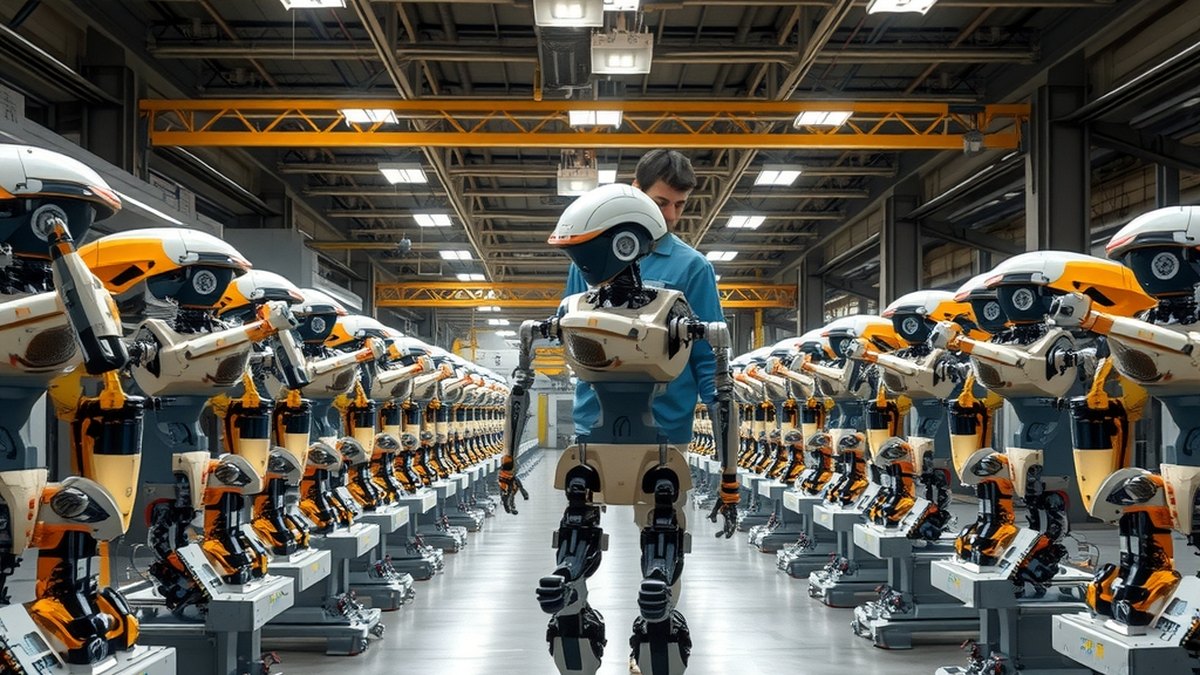
The company's Fürstenfeldbruck plant near Munich opened earlier this year and is rated for up to 10,000 legged and wheeled humanoid robots a year. That figure is a stated maximum. Forbes, as summarized by TechTimes, notes that it is not confirmed output and that the wheeled units it saw shipping were the only ones in circulation.
Agile Robots has not disclosed humanoid shipment counts, order totals or actual output from the plant. It does say it has deployed 20,000 industrial robotic solutions for customers in automotive, electronics, logistics and other sectors. Those industrial systems are a more established business than humanoids, and they give the company customer relationships that a new humanoid line can build on. The company has also not published a unit target for its full-size Agile ONE humanoid.
Where the Money Goes
Agile Robots says the new capital will go toward strengthening its U.S. presence, entering new markets, speeding up application development and adding production capacity, including in Germany. CEO Zhaopeng Chen has floated a future stock listing, though no timeline has been given. A public listing would require disclosing shipment and order data that the company has so far kept private.
A useful way to test the $8.5 billion valuation is against proof points. The company has deployed 20,000 industrial robotic solutions, but it has not disclosed humanoid shipments or revenue, the two figures that would most directly support a valuation of this size. Until they appear, the round reads as a bet on factory capacity and U.S. expansion rather than a record of humanoid sales.
Why It Matters
Humanoid robotics has moved from demonstrations to a question of manufacturing discipline. A plant rated at 10,000 units a year is a meaningful capacity claim, but investors and customers will care more about how many units ship, to whom and how well they perform on the job. Until Agile publishes those numbers, the valuation rests largely on expectations.
The U.S. expansion is also significant. American logistics and manufacturing buyers have been testing humanoid and mobile robots, and a European supplier with an industrial track record could compete on reliability and service rather than on hype. The company's 20,000-deployment base suggests it has experience with the support work that real factory customers demand.
For buyers, the practical lesson is to ask for deployment references, uptime data and total cost of ownership before committing to pilots. For investors, the round underscores that capital is still abundant for robotics leaders, but the bar for proof is rising.