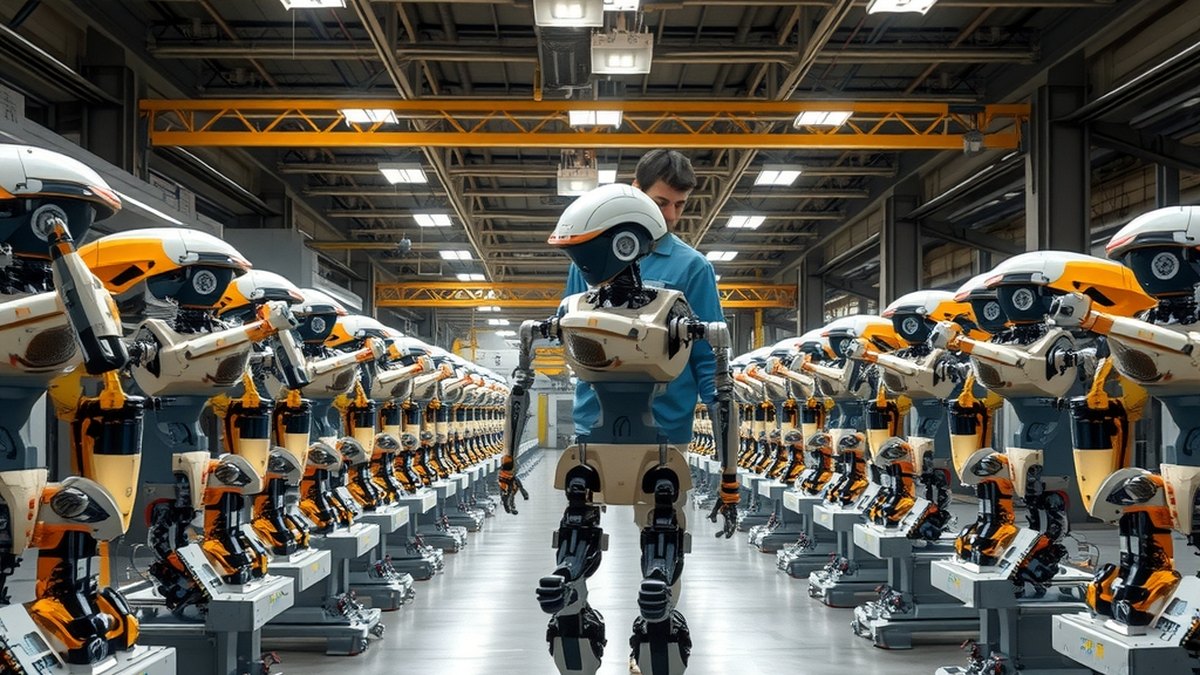
Nvidia used its GTC Berlin event to push its simulation-first robotics stack further, declaring Isaac Lab 3.0 generally available and expanding the Isaac platform with a runtime, datasets and reference workflows. The headline hardware is the Agile ONE SN, a compact research humanoid built on Nvidia's Isaac GR00T models and Jetson Thor compute, which Agile Robots says will be available at the beginning of 2027.
What Nvidia Added to Isaac
Isaac Lab 3.0 is the company's training framework for reinforcement learning and physics-based robot control. Nvidia also introduced Isaac OS, an open-source runtime designed to connect robot sensors, AI models, control systems and hardware into one stack. The goal is to make the path from simulation to a physical machine less fragmented.
Developers also get a SimReady Central Library with more than 2,000 simulation-ready robotics and factory assets, and a Human 1M Dataset of human activity recordings that include 3D hand-tracking data. Nvidia published reference workflows that combine GR00T, its Cosmos world models and reinforcement learning to generate synthetic data and train manipulation skills.
These pieces matter because robot developers have long struggled with data. Real-world demonstrations are slow and expensive to collect, so shared assets and synthetic data are a practical way to multiply what a team can test.
The Agile ONE SN
Agile Robots describes the Agile ONE SN as a compact humanoid for research and development. It is meant for building, training and validating humanoid skills in the lab before those skills move into real-world deployments. The company lists the robot at 1.4 meters tall and 43 kilograms, and says its body has 31 degrees of freedom. Some coverage gives a different weight, around 40 kilograms, so buyers should check the final datasheet.
The robot is the compact reference platform in Agile Robots' humanoid portfolio. Its full-size counterpart, Agile ONE, is aimed at industrial applications, and the company says skills and data developed on the SN can later transfer to that model. Compute comes from Nvidia's Jetson Thor, and the stack supports Isaac Sim and Isaac Lab through URDF and USD assets.
Availability is scheduled for the beginning of 2027, so this is a forward-looking platform rather than something factories can order today.
Simulation as the Main Route to Deployment
Simulation is increasingly the main way robotics teams prepare for deployment. Toyota Material Handling Europe and SoftServe say simulation-based development can cut commissioning time by up to 50 percent. That is the kind of saving integrators care about, because it reduces the time a production line sits idle while a robot is set up.
The partner list shows how broad the push has become. ABB Robotics is integrating Omniverse libraries into its RobotStudio HyperReality environment for virtual commissioning. Kuka is using Omniverse through Visual Components' FactoryLens. Sereact is building its Cortex manipulation platform with GR00T and Cosmos Transfer, and Neura Robotics is training its Neuron AI foundation model with Isaac Sim and Isaac Lab.
Taken together, these integrations suggest Nvidia wants to be the common layer under many robot makers rather than a builder of robots itself.
Why It Matters
Physical AI is constrained by data and by the cost of testing on real hardware. Simulation lets teams try thousands of variations of a task before a robot touches a part, which is why the shift toward simulation-first development is accelerating across manufacturers and research labs.
Shared formats and asset libraries also matter for interoperability. When an industrial integrator and a research lab use the same models and assets, a skill developed in one setting has a better chance of carrying over to another.
Still, the reference humanoid is not yet a product, and its timeline runs into 2027. Demonstrations in simulation do not automatically transfer to factory floors, and the gap between simulated and real-world performance remains the central engineering problem in robotics. Companies evaluating these tools should look for evidence from deployed systems, not only from simulation benchmarks.
For different readers, the announcements point in different directions:
- Industrial integrators should watch the virtual commissioning tools from ABB, Kuka and Visual Components.
- Research labs can start with the Isaac Lab 3.0 release and the reference workflows.
- Robot developers get a shared runtime through Isaac OS, which could reduce integration work over time.
The next test will be whether these tools move from keynote demos into shipping systems during 2027.